Background on the Lafarge Morocco Site Visit
About thE APP:
This tool was designed by members of the 2015 Executive Masters of Natural Resources Program (XMNR) for the Center for Leadership in Global Sustainability (CLIGS) as a primer for future XMNR students or CLIGS staff who may be interested in developing a sustainability project built off of the relationship that was established with LaFarge Morocco during the 2015 International Residency. The intention of this tool was to re-create the experience students had during their brief visit of the site through a geospatial representation of the tour capturing the dialogue that took place during the day and information that was received during the presentation about the company.
OUR MORNING WITH LAFARGE MOROCCO:
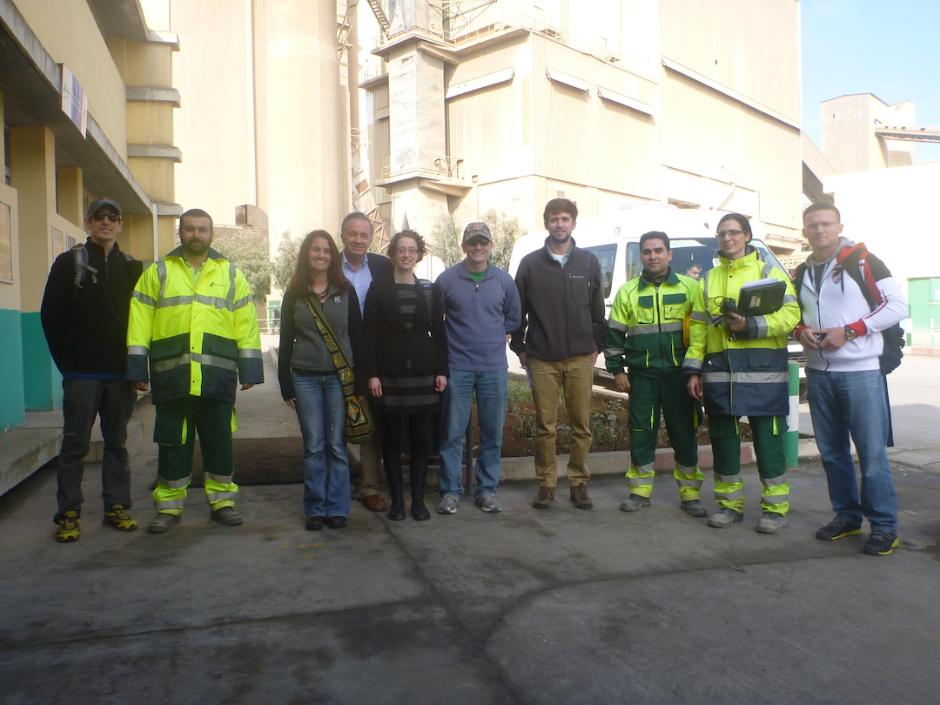
In January 2014, students from the XMNR Cohort traveled to Bouskoura, Morocco to visit the LaFarge Cement Plant as a part of the program’s international residency. There, they met with production manager Hadia Gerardin, who delivered a presentation on the organization’s mining procedures, cement plant operations and land remediation practices. Afterwards, the students were given tours of the quarry and facility.
INITIAL REACTION: A SOPHISTICATED LAND RECLAMATION EFFORT
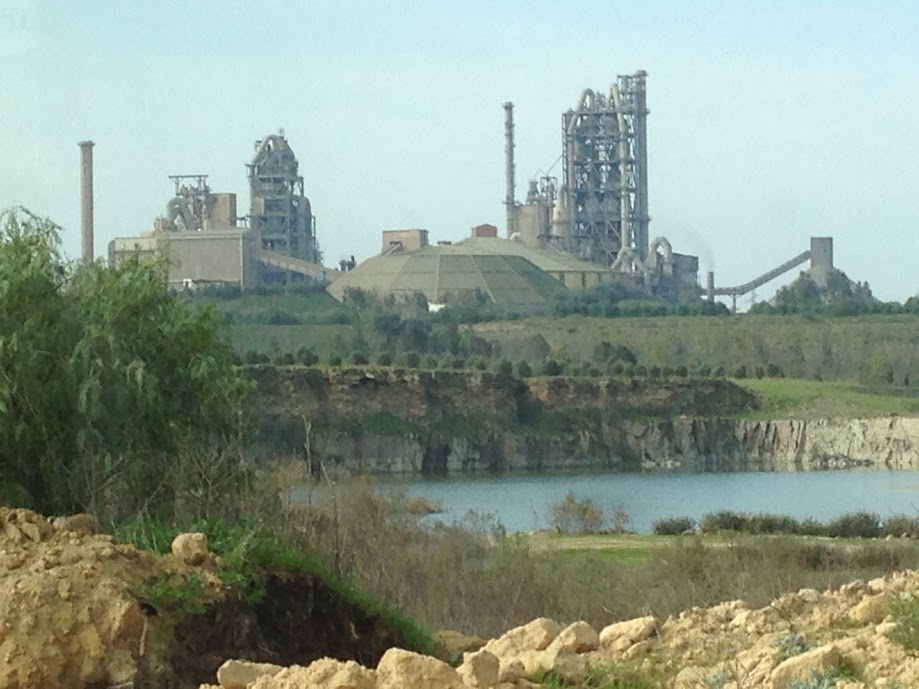
As one of the leading providers of cement in the world, the students were impressed by the scale and efficiency in their extraction and production processes. However, although none of them had ever experienced a quarry of this scale, this type of presence was expected. What was most unexpected, was the scale and dedication to their land remediation practices. When debriefing the site visit, students from the group had described the feeling of being in a recreation area instead of an abandoned mine.
IDENTIFIED OPPORTUNITY: OUTREACH AND COMMUNITY ENGAGEMENT
A major gap that was a common theme identified by students was a potential for community engagement opportunities with the surrounding area. On the drive to and from the site, students noticed continued development in the surrounding area, including modern housing community and a luxury resort. This construction was in stark contrast to the vast acreage of farmland devoted to cereal crops and grazing. That said, the students admittedly were only able to take a quick snapshot of the surrounding area as they drove by on their way to and from Casablanca to the cement plant.
While on the tour, LaFarge Staff did mention that social responsibility with local communities is a priority for them. They explained that they give some of the trees that they grow during the remediation process to local communities. However, they also mentioned a mixed impression of their presence by some of the surrounding communities, with one worker stating that some people “they don’t totally grasp all the things that we are doing at the plant.” 
- Our advice to a future cohort whom might be interested in continuing this relationship with LaFarge would be to “zoom out” of the map after you finish your virtual tour of the plant.
- We believe it is important to uncover some of the forces and relationships that surround the greater landscape around the plant (as well how it is continuing to be reshaped)
- In uncovering these factors, LaFarge may be able to better understand its role in context to the surrounding community. Once taken into consideration, recommendations could be on ways in which they could be using their current remediation efforts for a means of mutually-beneficial outputs for both the community and the plant.
About LaFarge Morocco:
Lafarge Group is one of the world-leading suppliers of building materials, specializing in the production of cement, construction aggregates and concrete products. Lafarge’s involvement with the construction sector in Morocco since 1928, when it created the "Moroccan Society of Lafarge Ciments" after an extensive study tour by then CEO Charles Daher. Soon after, the company acquired 150 hectares in Roches Noires (near eastern Casablanca), with production beginning after the installation of its first rotary kiln in 1930. Over the next fifty years, Lafarge Morocco added a second plant in Meknes (approximately 250 kilometers east of Roches Noires) and increased its capacity from 120,000 to 1,350,000 tonnes per year. Due to this exponential increase, LaFarge Morocco recognized the Roches Noires would approach capacity much sooner than originally anticipated. In 1983, the company acquired the Bouskoura site that the XMNR team visited.
 As production continued to increase, the company experienced organizational expansion and changes as well. In 1995, Lafarge Morocco became an equally-owned partnership with SNI/ONA (controlled by King Mohammed VI), Morocco’s leading industrial group. Three years later, the company was first listed on the Casablanca stock exchange. Along with the increased visibility, Lafarge Morocco developed an active investment policy during this time in response to the demands of its rapidly developing country. Investments included the construction of a third plant and quarry in Tétouan in 2004 and a new production line at the Bouskoura plant.
In addition to capital expenditure to meet production demands, the company broadened its development policy to include skill development and training (with an emphasis on employee safety), contribution to the economic and social development of the country and sustainable development. Today, spending on environmental protection accounts for about 15% of the company’s total investment. After successfully improving the environmental standards of its industrial sites, Lafarge Morocco has launched environmental management systems that meet the ISO 14001 global standard.
Today, LaFarge is responsible for 35% of cement market in Morocco. Much of the cement produced is made into concrete, which is mostly being used in Morocco for public projects. This includes bridges and infrastructure as well as for buildings with the King Mohammed VI’s recent affordable housing project. They also have been selling significant amounts to ONCF (Moroccan National Railways Office) for use in the construction of the Casablanca—Tangier high-speed rail line.
ABOUT CLIGS
The Center for Leadership in Global Sustainability (CLiGS), a center within Virginia Tech’s College of Natural Resources and Environment (CNRE) and based in the National Capital Region (NCR), provides education, research, and leadership to navigate in a rapidly changing world towards a more sustainable future. Bringing together faculty and students from Virginia Tech with partners from other educational, business, civic, and government institutions, CLiGS is dedicated to exploring and facilitating collaborative approaches to sustainable development in globally interconnected ecological, economic, and social environments. CLiGS offers a range of graduate education and professional development programs to prepare students to be leaders in environmental and natural resource sustainability.
ABOUT XMNR
Virginia Tech’s Executive Master of Natural Resources (XMNR) program is an accelerated, 14-month graduate degree for full-time working professionals with significant prior work experience. Students represent a wide range of organizations in the public and private sectors throughout the Washington, DC region and beyond. Immediate program outcomes include organizational and policy changes while long-term outcomes include personal and cultural transformation.